Retail market
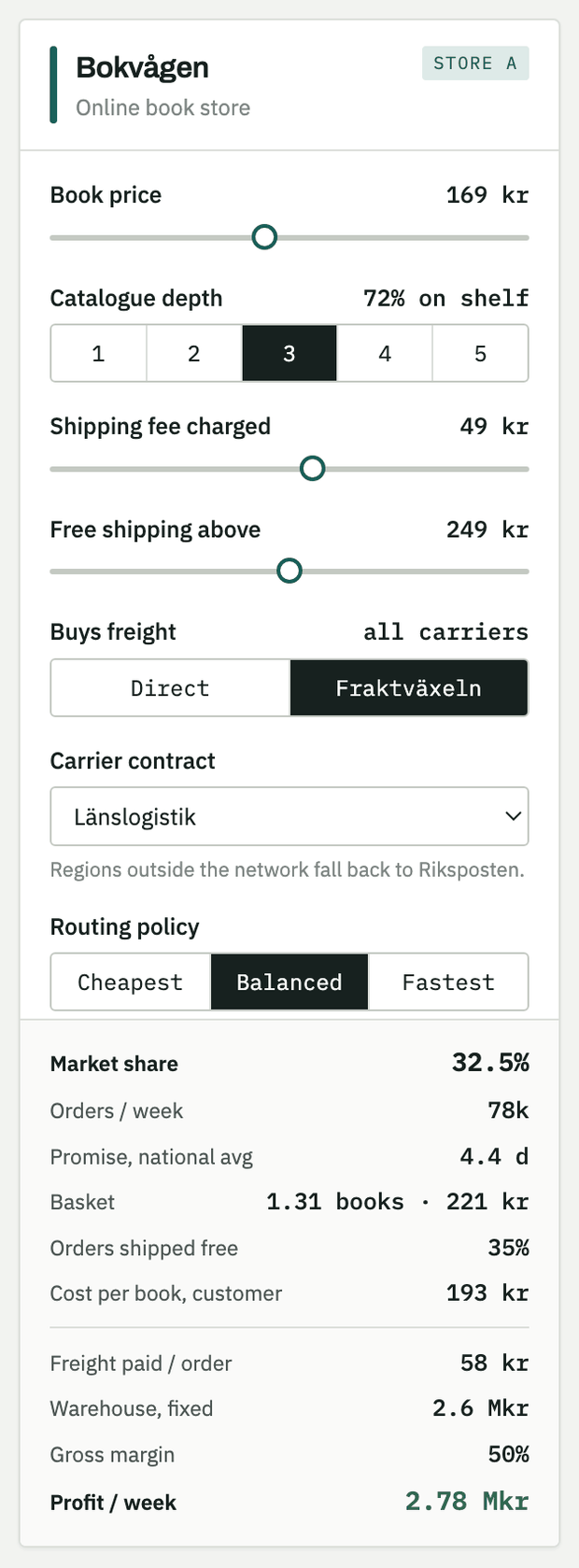
Same books, same wholesale price. Customers only see price, shipping fee and the promised delivery day.
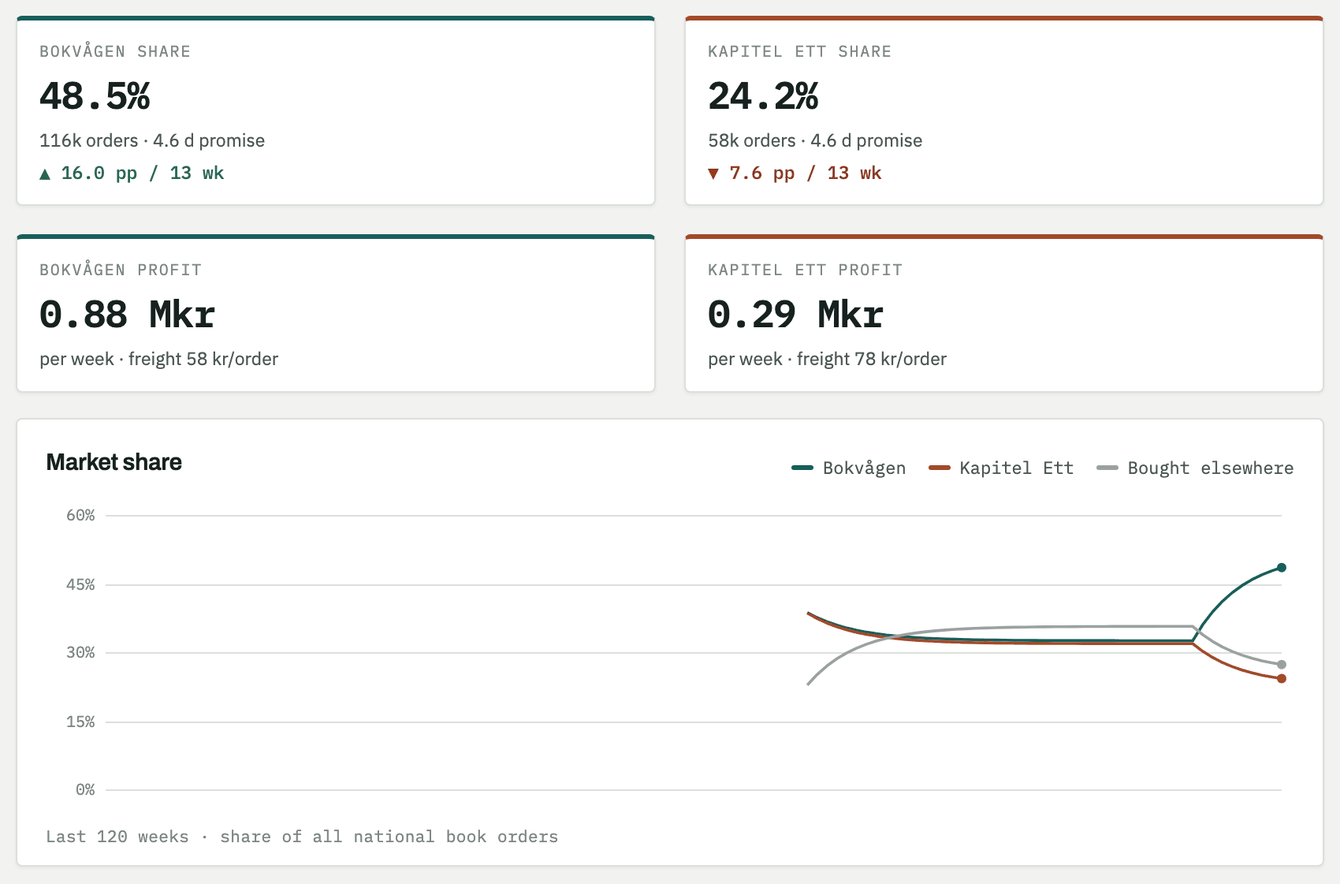
Market share
Last 120 weeks · share of all national book orders
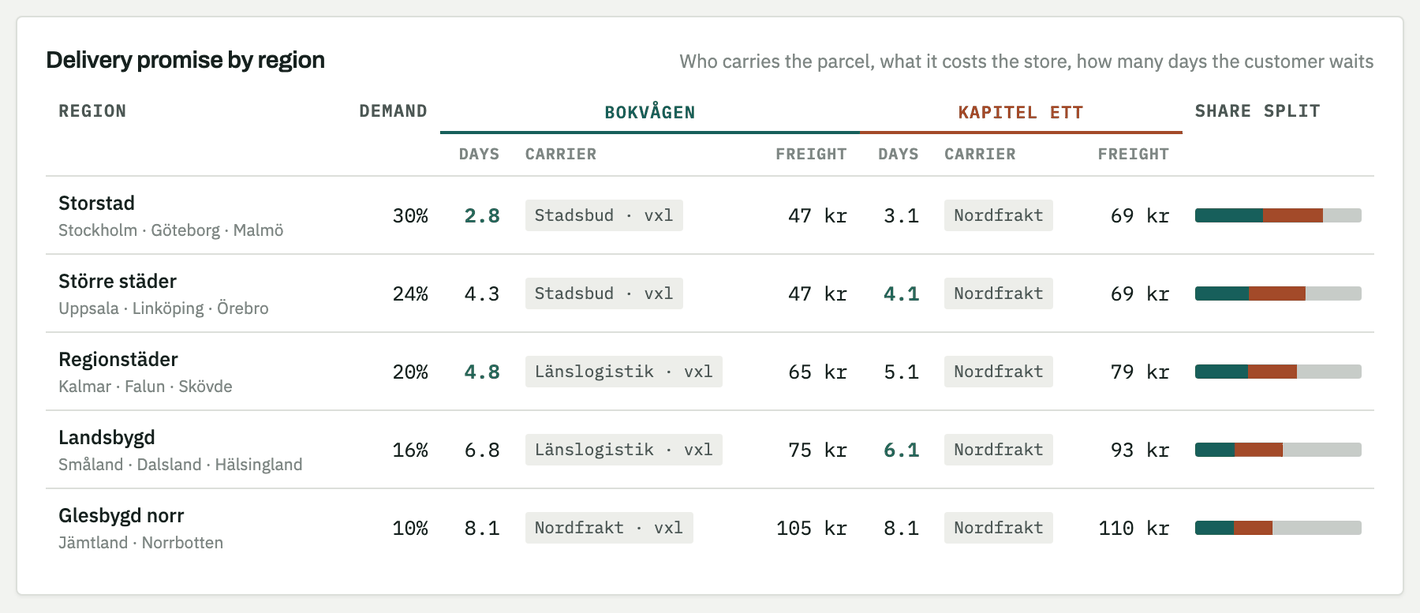
Delivery promise by region
Who carries the parcel, what it costs the store, how many days the customer waits
| Region | Demand | Bokvågen | Kapitel Ett | Share split | ||||
|---|---|---|---|---|---|---|---|---|
| Days | Carrier | Freight | Days | Carrier | Freight | |||
Logistics market
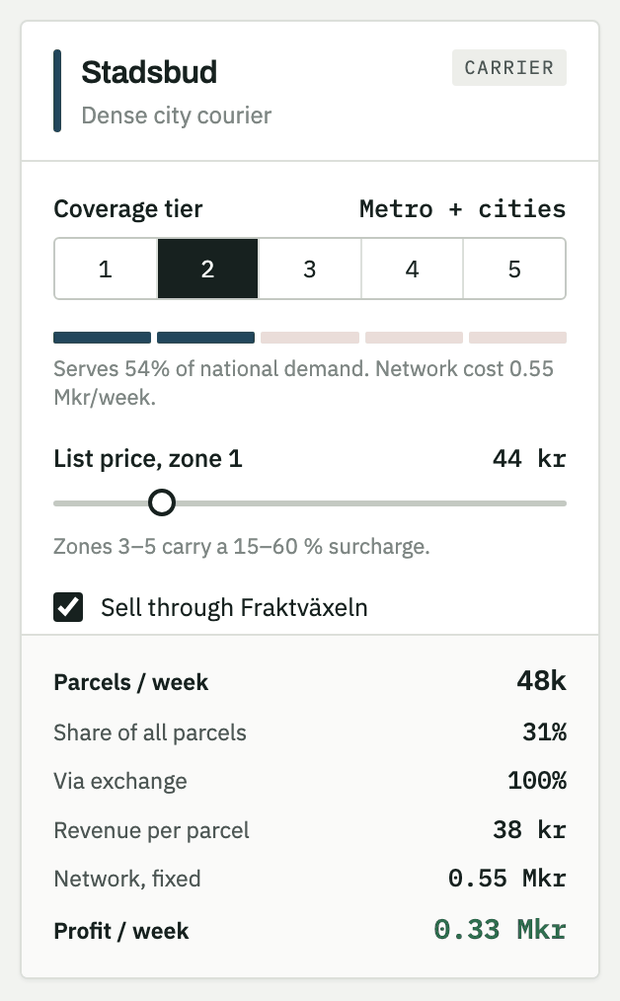
The stores are the only customers here. Carriers sell coverage and price; the exchange sells access to all of them at once.
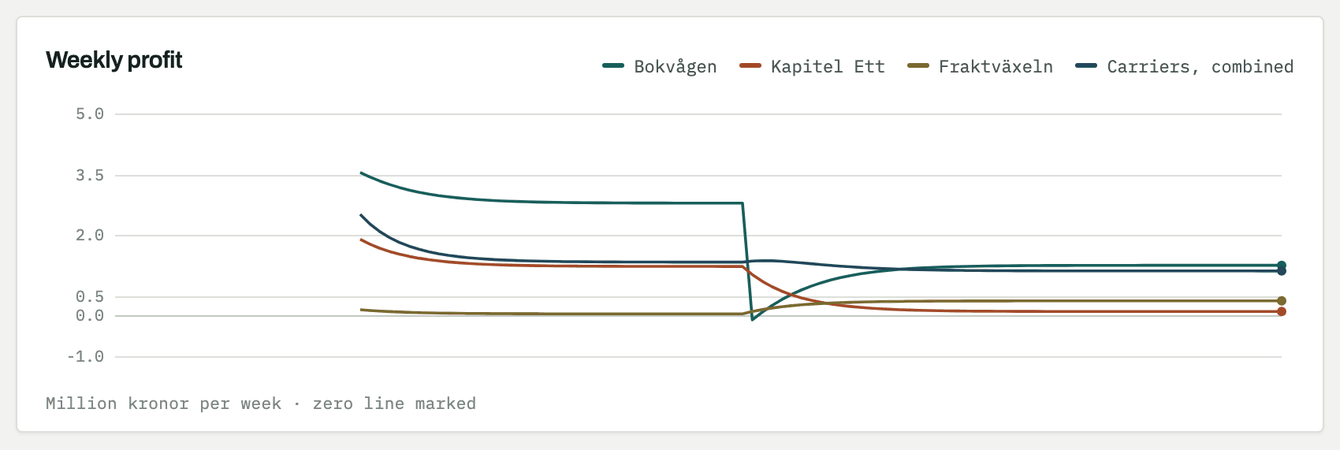
Weekly profit
Million kronor per week · zero line marked
What the model actually does
Customers
240 000 book orders a week, split across five geographies. Each region chooses between the two stores and staying home, on cost per book and promised days. Metro customers weigh a day saved almost twice as heavily as Norrland; Norrland weighs kronor harder.
Stock depth becomes speed
A store's catalogue tier sets how often the title is on its own shelf. In stock ships in a day; anything else waits on a publisher order and adds three. Depth is bought with fixed warehouse cost, not with freight.
Free shipping is not free
Raising the threshold pushes baskets up, but every order that clears it hands the freight bill to the store. A store buying the cheapest zone rate can afford a promise a store on list price cannot.
Coverage gaps get expensive
Buying direct from one carrier means every region beyond its network falls back to Riksposten basic: 92–147 kr and three extra days. Both stores must serve the whole country, so the gap is paid either in kronor or in days.
What the middleman sells
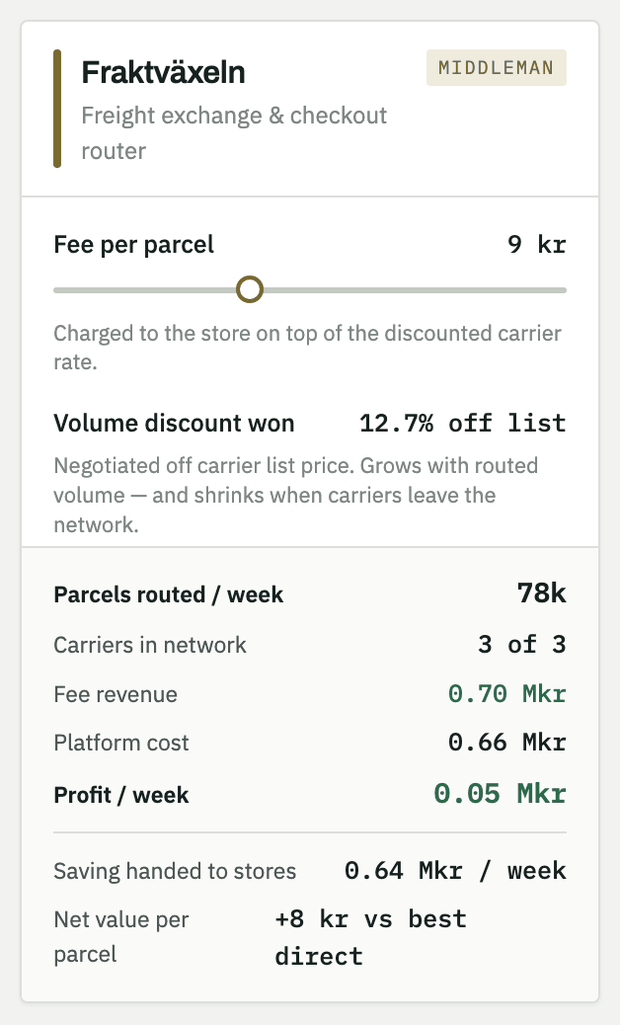
The exchange aggregates volume into a discount off carrier list prices, picks a covering carrier region by region under the store's policy, and charges a flat fee per parcel. Its discount grows with the volume it routes, so its own value is self-reinforcing — and collapses if carriers leave the network.
Illustrative, not forecasting
Elasticities are tuned so a ten-krona move is visible within a few weeks. Shares carry inertia; nobody switches store overnight. Treat every number as a direction, not a prediction.